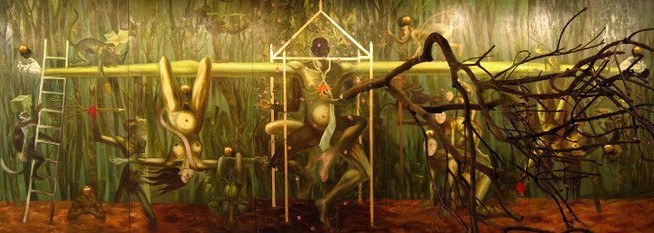
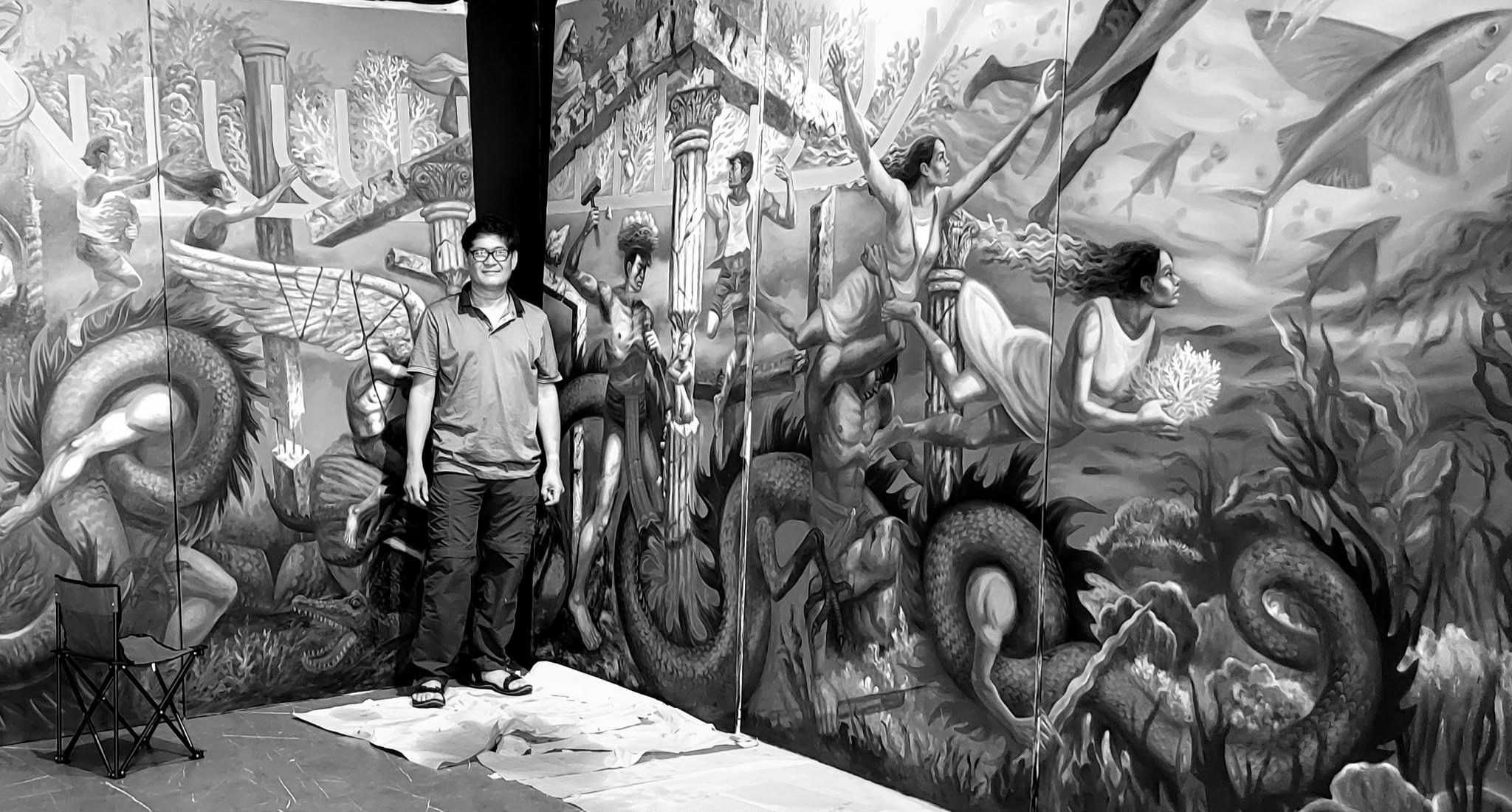
There is a painting by Jeho Bitancor that is twenty feet long and refuses to let you stand still in front of it. Memento Mori is less a picture than a corridor — a green, submarine, fever-lit expanse you must walk the length of, the way you walk the length of a wake. Monkeys the color of old ivory crouch among the reeds; a ladder leans against nothing; bodies dissolve into vegetation and vegetation hardens into bone. It was the canvas he painted in 2006 as his centerpiece for the 13 Artists Award, and it already contains the whole argument he has spent his career prosecuting against himself: that a painting can be ravishing and still be an indictment, that the eye can be seduced and the conscience kept awake at the same time. Most artists pick one. Bitancor, stubbornly, irritatingly, magnificently, has never agreed to.
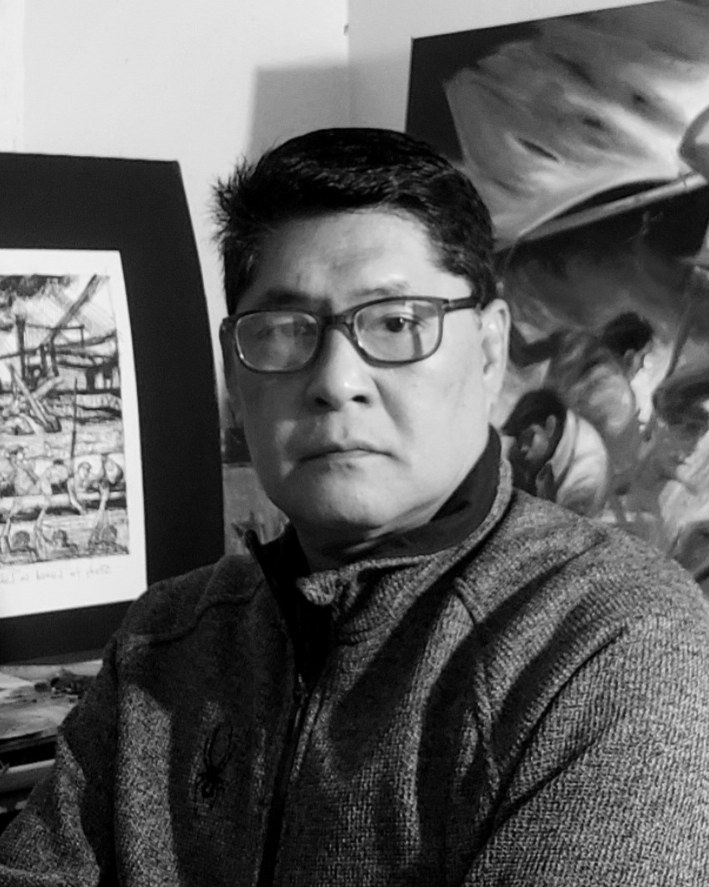
He will tell you where the trouble started. “My formative years as an artist were characterized by uncertainties,” he writes in his statement, with the flat candor of a man reporting weather. At the University of the Philippines in the 1980s — College of Fine Arts, painting and visual communications, 1984 to 1992 — he was mentored by some of the prime movers of Philippine art and discovered that they were at war. On one side, Social Realism, the belief that art is a means, a tool you pick up to do something in the world. On the other, Conceptualism and the seductions of pure form, the belief that art is an end, sufficient unto itself. Bitancor, with the mischief that never quite leaves his voice, reduces the whole quarrel to a prizefight: “Clement Greenberg versus Bertolt Brecht in simple terms.”
He could not choose. More precisely, he refused the terms of the choice. He was drawn to Greenberg’s claim to art’s autonomy — its right to be beautiful for no one’s sake but its own — and at the same time loyal to the Brechtian dictum that a chair must be sat upon and not be treated alone as an object to behold. That sentence is the key to everything. It is also, when you think about it, very funny: a young painter standing in a studio, staring at a chair, paralyzed by the metaphysics of furniture. The dilemma he names is real and total — “whether painting a dot on a blank canvas,” he writes, “or painting the story of Maria would serve my purpose as an artist.” Greenberg wants the dot. Brecht wants Maria. Bitancor wanted both, and concluded that the contradiction was “inherently irreconcilable.” So he did the only honest thing. He stopped trying to resolve it and started living inside it.
Living inside the contradiction, however, did not mean remaining undecided. “I still value art’s autonomy,” Bitancor clarifies, “but I do what I do because, in the end, I chose to serve my context.” His raison d’être for artmaking is to reflect on, make sense of, and make do with what he has been given: his material condition and its historical consequences. That choice does not preclude innovation or the possibility of mapping uncharted territories; it gives exploration a point of departure. As he puts it, “All art is context-based, and serving one’s own is not a sin.” The lamppost does not fence the artist in. It gives him light enough to see where he stands—and perhaps where else he might go.
“A chair must be sat upon and not be treated alone as an object to behold.”Jeho Bitancor, Artist’s Statement
The boy from Baler
To understand why he couldn’t simply take the safe, fashionable road of pure form, you have to go back to Baler, in Aurora — the Pacific-facing edge of Luzon, the place where the surf comes in hard and the rest of the country feels very far away. Bitancor was born there in 1967, and the province has never let go of him; he would later found the Baler Art Group, serve as artistic director of its festival of the arts, and be named, in 2005, Dangal ng Aurora — the pride, the honor, of Aurora. The kid was a prodigy of the small-town variety, which is to say he won everything. A silver medal at the Kanagawa World Children’s Art Exhibition in Japan in the early 1980s. First place in poster competitions whose themes read now like a syllabus of a politicized youth: “Human Rights.” “Militarization.” “Nuclear Arms Race.” This was the Marcos era; in the Philippines of the 1980s, a teenager who could draw was already, whether he liked it or not, a teenager taking a side.
And here is the detail that unlocks the man: he is also a poet. In 1987 he took first place at the Valerio Nofuente Memorial Awards for Literature for a collection with the gloriously unsentimental title Makinasyon at iba pang tula — Machination, and Other Poems. Once you know that, the paintings reorganize themselves in front of you. They are not illustrations and they are not slogans. They are stanzas — dense with metaphor, built on juxtaposition and metamorphosis, demanding to be read as much as seen. “I rely heavily on my imagination,” he writes, “while employing juxtaposition, alterration and metamorphosis to create allegories, ironies, parodies and parallelisms.” That is not an artist’s statement. That is a poet describing his toolbox.
The body as the last honest map
Bitancor belongs to what the histories now call the second generation of Filipino Social Realists — the inheritors of the movement that turned Philippine painting into a form of testimony. But where the first generation often reached for the legible image, the protest you could read from across the room, Bitancor reached for the body: stretched, multiplied, flayed, gilded, crucified on the architecture of the everyday. The human figure is his fundamental unit of meaning, and he does astonishing, almost cruel things to it.
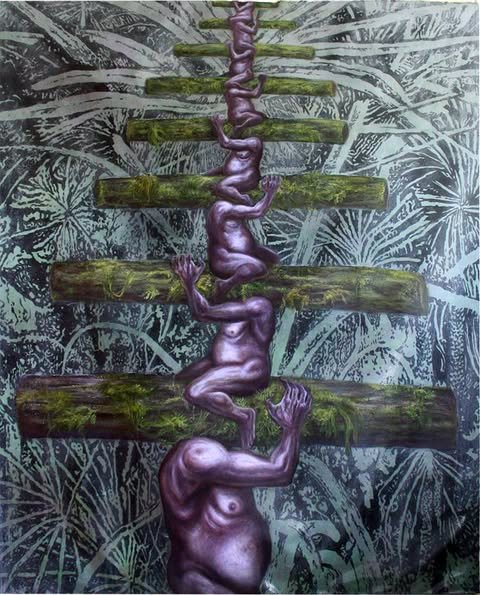
Look at Kami-Kami lang, Amin-Amin lang — the title a bitter little idiom of cronyism, roughly Just Us, Just Ours, Among Ourselves. A column of violet-skinned figures climbs a vertical totem of mossy, lashed-together crossbars, each body straining upward over the one below, against a hallucinatory thicket of silvered foliage. It is a corporate org chart rendered as a botanical crucifixion. It is also, in the way of all his best work, beautiful enough that you almost forgive it for what it is telling you about how power stacks itself.
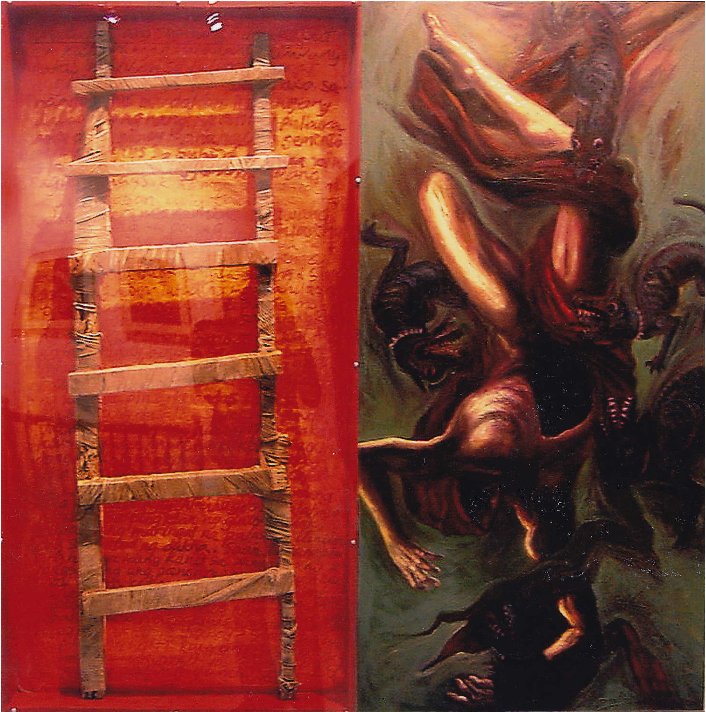
Or consider the diptych Nais kong tumulay sa Bahaghari kahit na ang Bangungot ay Kumikitil — I Want to Walk Across the Rainbow Even as the Nightmare Strangles Me. On the left panel: a bound, ascending ladder, its rungs wrapped and lashed, set against a wall of red and ghosted handwriting — the dream of escape, literally tied up. On the right: a body falling through ochre space, set upon by a pack of small dark creatures, a tumbling Baroque agony lifted out of a Rubens hunting scene and dropped into a Filipino nightmare. The title alone is a poem; the painting is its devastating second half. Hope as a ladder you cannot quite climb. It is, frankly, a tearjerker, and it earns the tears honestly — through composition and color, not pleading.
Allegories that bite
Then there is the comedy — because Bitancor, mercifully, is funny, in the way that the most serious political painters from Goya to George Grosz have always been funny. His satire runs on what he calls “parodies and parallelisms,” and it is at its most savage around a dinner table.
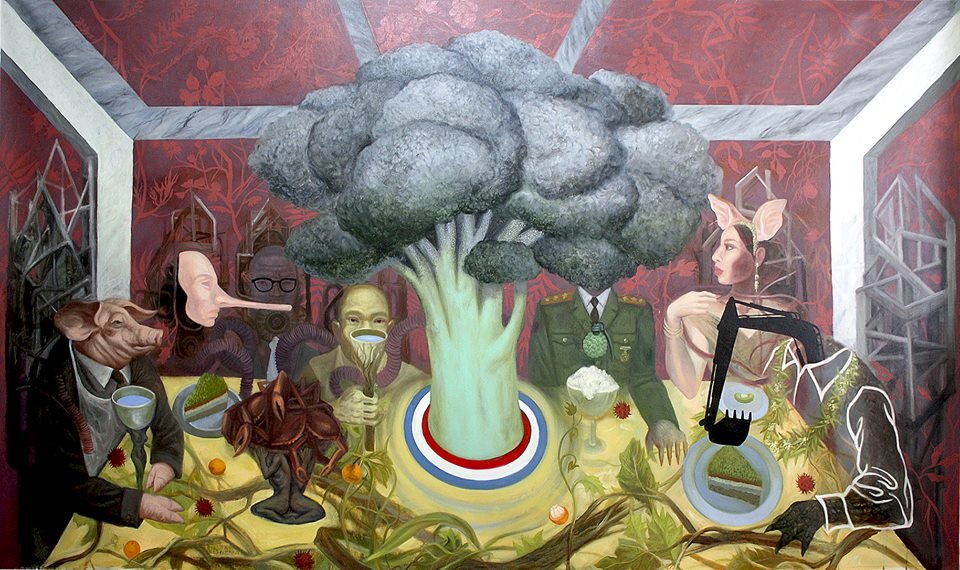
In Ang Piging — The Feast — a tribe of grotesques sits down to dine. A pig in a business suit lifts a goblet of blue fluid. A long-nosed liar leans in. A military officer presides. A woman with the ears of a rabbit turns away in profile. And at the center of the table, where nourishment should promise continuance, an enormous head of broccoli swells into the unmistakable silhouette of a mushroom cloud. This is the painting’s terrible simultaneity: food, the thing meant to nourish and sustain life, presented at the same time as devastation itself. The inspiration, Bitancor explains, is the rise of fascists and narcissists who dictate the terms by which life must be conducted and lived. The banquet becomes both meal and blast site, sustenance transformed into domination. The joke is the indictment. You laugh, and then you notice what you are laughing at.
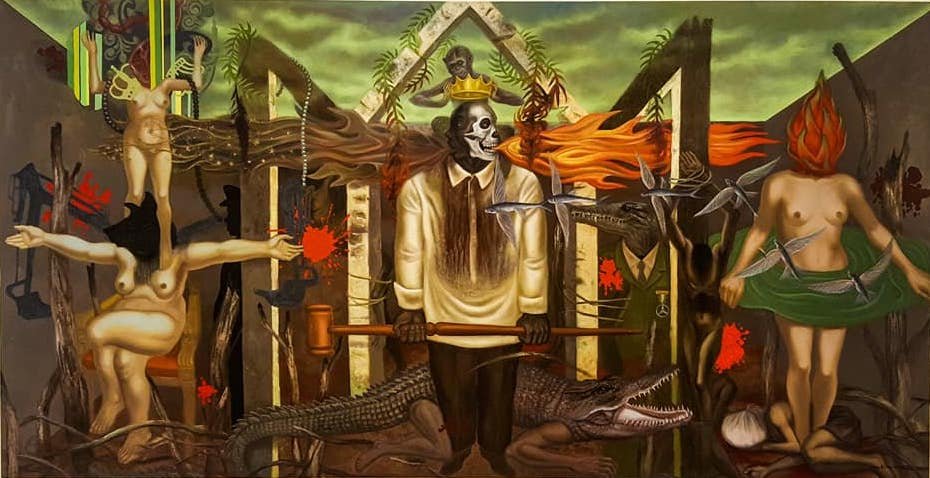
The satire turns to outright horror in I See No One But Me. A figure in a clean white barong-style shirt stands dead center, sleeves rolled, gripping a wooden mallet — the posture of a respectable man, an official, a judge — except that where his face should be there is a grinning skull. He is flanked by two nude women, one thrown into a cruciform sprawl, one kneeling in a skirt of silver fish; crocodiles wait at his feet with their mouths open; a small crowned figure perches on the pediment above, presiding over a sky the green of an oncoming storm. The title is the diagnosis. This is what radical solipsism looks like when it dresses for the office: a man who has narrated himself into being the only real person in the room, surrounded by bodies he no longer registers as human. It is one of the most chilling paintings in contemporary Philippine art, and it does not raise its voice once.
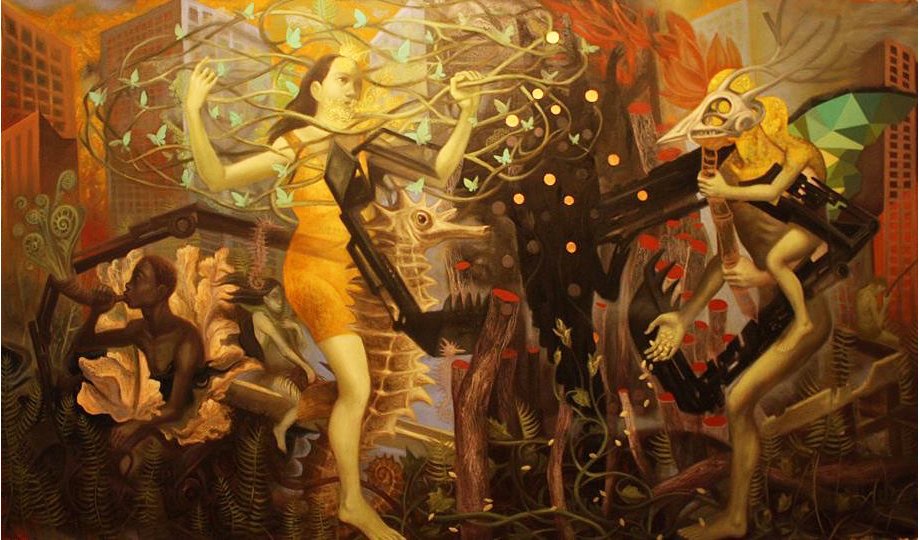
Its companion in fury is Pagtutuos — The Reckoning, or Settling of Accounts. Against a burning amber cityscape, a woman in a yellow dress and a skull-masked figure each wield enormous black machine guns, while butterflies, vines, and a marooned seahorse erupt from the chaos around them. It is apocalypse rendered in the colors of a sunset you’d photograph. Beauty and violence sharing a single palette — the Bitancor signature, the irreconcilable contradiction made paint.
“Sometimes the minutiae of everyday life becomes a macrocosm of society.”Jeho Bitancor
The grammar of displacement
In 2007, Bitancor’s life split in two. His achievements in the visual arts were sufficient for the United States government to grant him an “Alien of Extraordinary Ability” visa — a bureaucratic phrase so perfect for this particular artist that you suspect the universe of editorializing. The man who paints metamorphoses and aliens and bodies that are never quite at home in their own world was officially classified, by an immigration form, as an extraordinary alien. He moved to the United States with his family and threw himself into “its complex cultural landscape,” and the work acquired a new and aching subject: displacement itself.
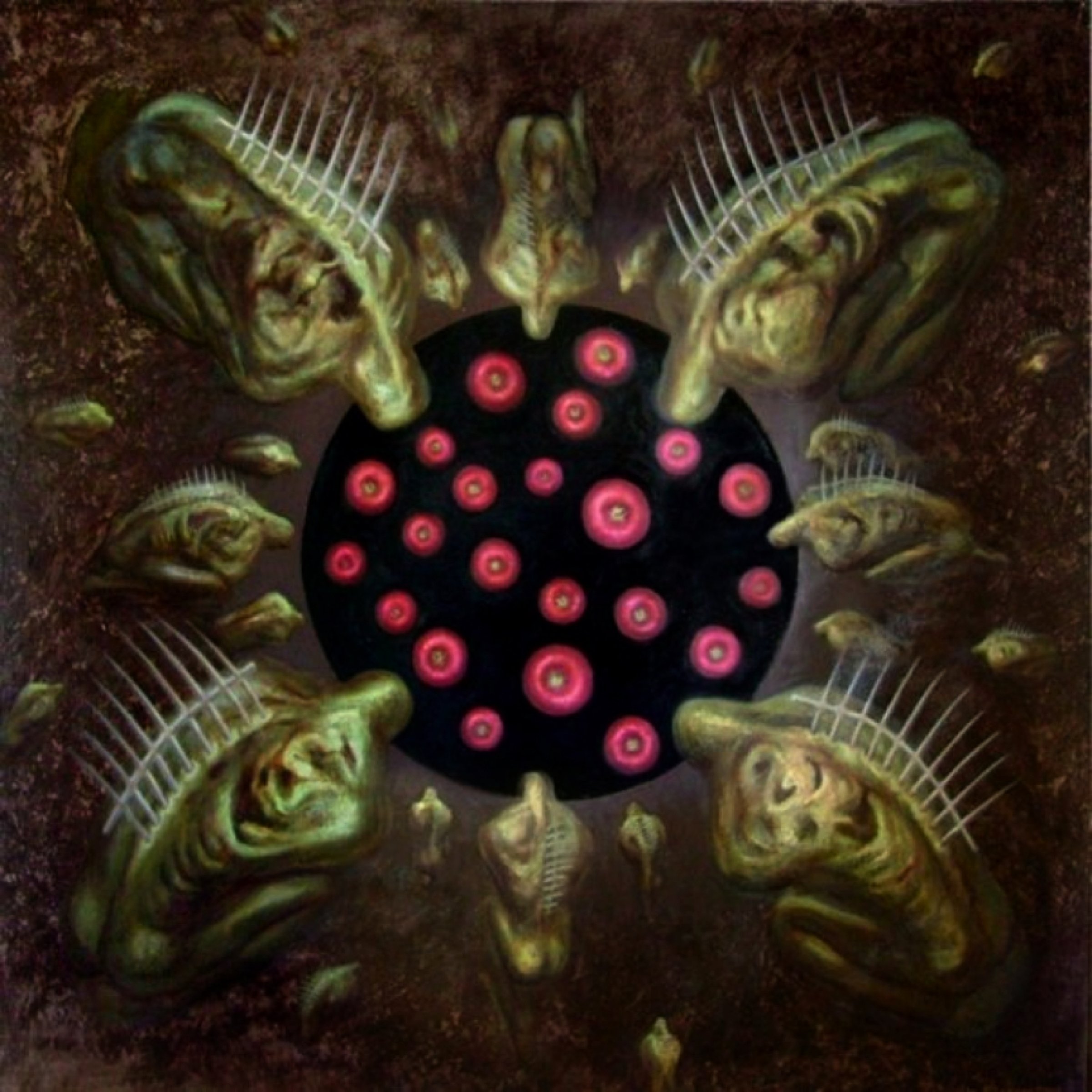
Diaspora is the great early statement of this turn — a mandala of contorted figures arranged radially around a black void studded with glowing pink ova, each body crowned with a fan of needle-thin spines, like seeds flung centrifugally from a pod that has burst. It is the scattering of a people rendered as a single, terrible, almost liturgical pattern. From a distance it reads as ornament. Up close it is a wound. That doubleness — decoration that turns out to be diagnosis — is the engine of his entire aesthetic.
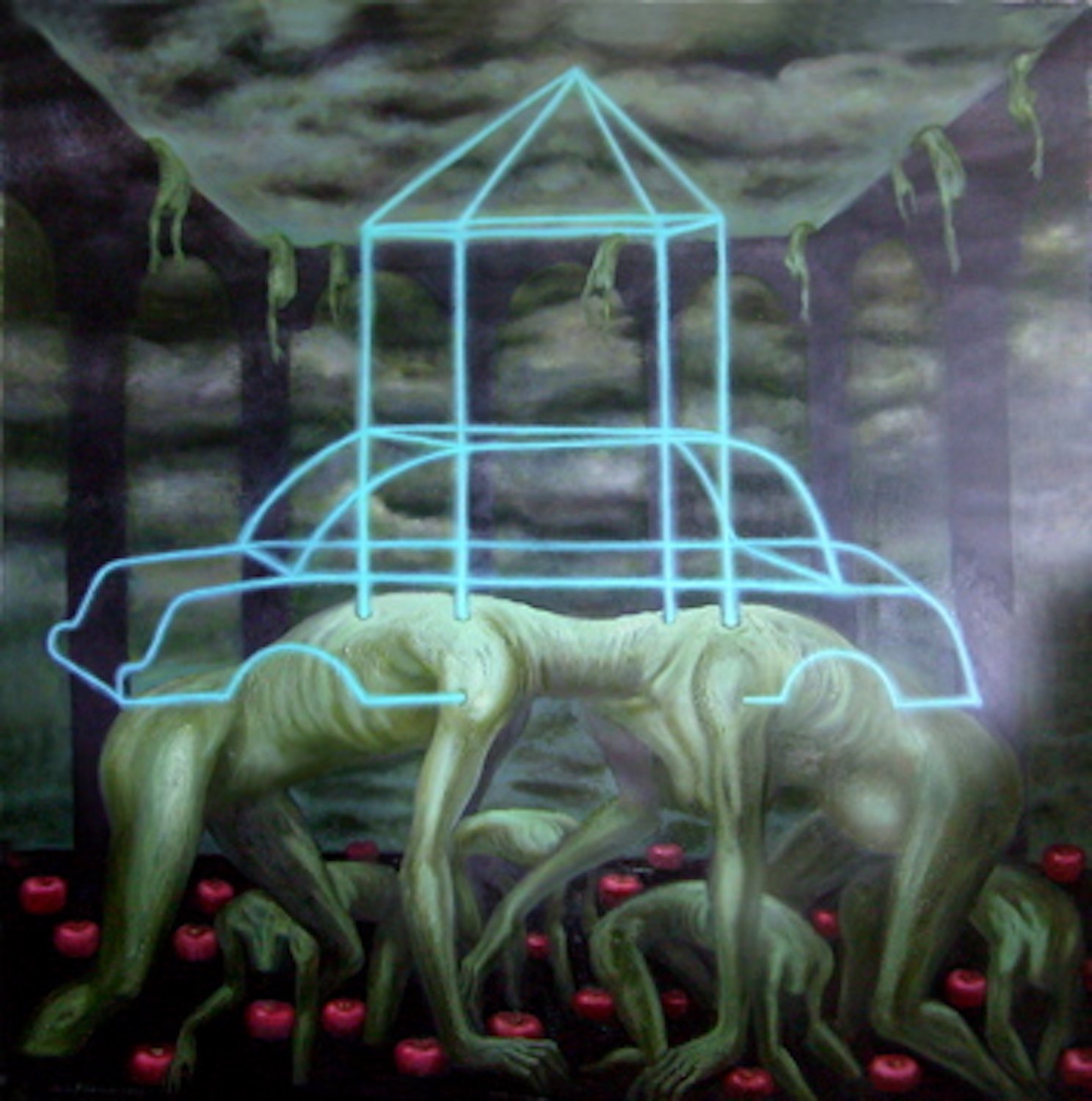
Trapped, made the same fateful year, is its quieter twin: pale green figures crawl on all fours beneath the cold blue neon outline of a car and a house — the twin altars of the migrant dream — across a floor littered with red apples, that recurring Bitancor symbol of forbidden, poisoned, or merely impossible desire. (He once staged a whole performance piece, at the ASIATOPIA festival in Bangkok in 2006, called Spitting at the Red Apple. The apple has been on trial in his work for a long time.) Here the new house and the new car are not solid at all; they are weightless line drawings, promises with no mass, and beneath them human beings have been reduced to a crawl.
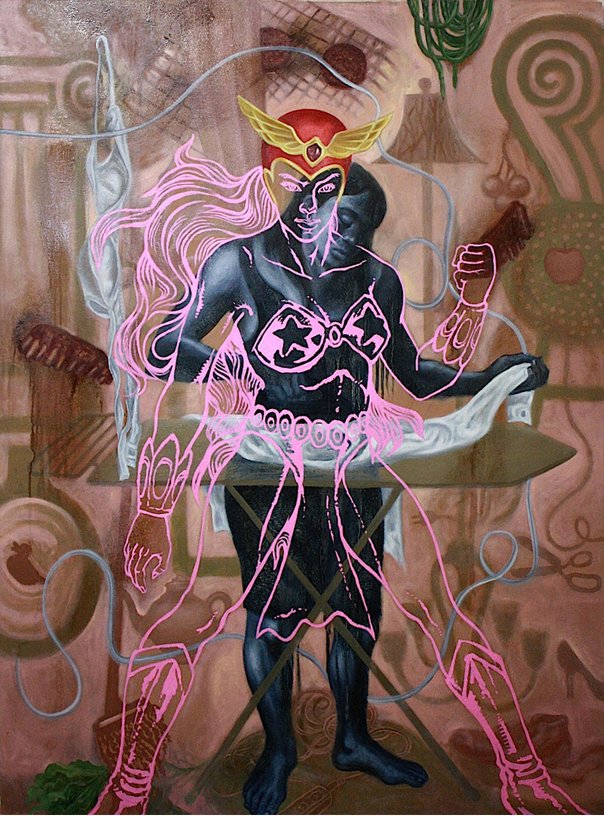
And then, the strangest and most tender of them: Ako si Darna — I Am Darna. Darna is the Filipina superheroine, the comic-book demigod every kid in the archipelago grows up on. Bitancor paints her as a dark, near-black figure standing at an ironing board, doing the most domestic labor imaginable — while a second self, drawn in floating pink contour line, the idea of Darna, the winged-helmet fantasy, peels away from the laboring body like a soul that can’t quite leave. It is the immigrant condition, the OFW condition, the condition of every person who is a hero in one story and a household worker in another, compressed into a single image. You could write a dissertation on it. You could also just stand there and feel your throat tighten.
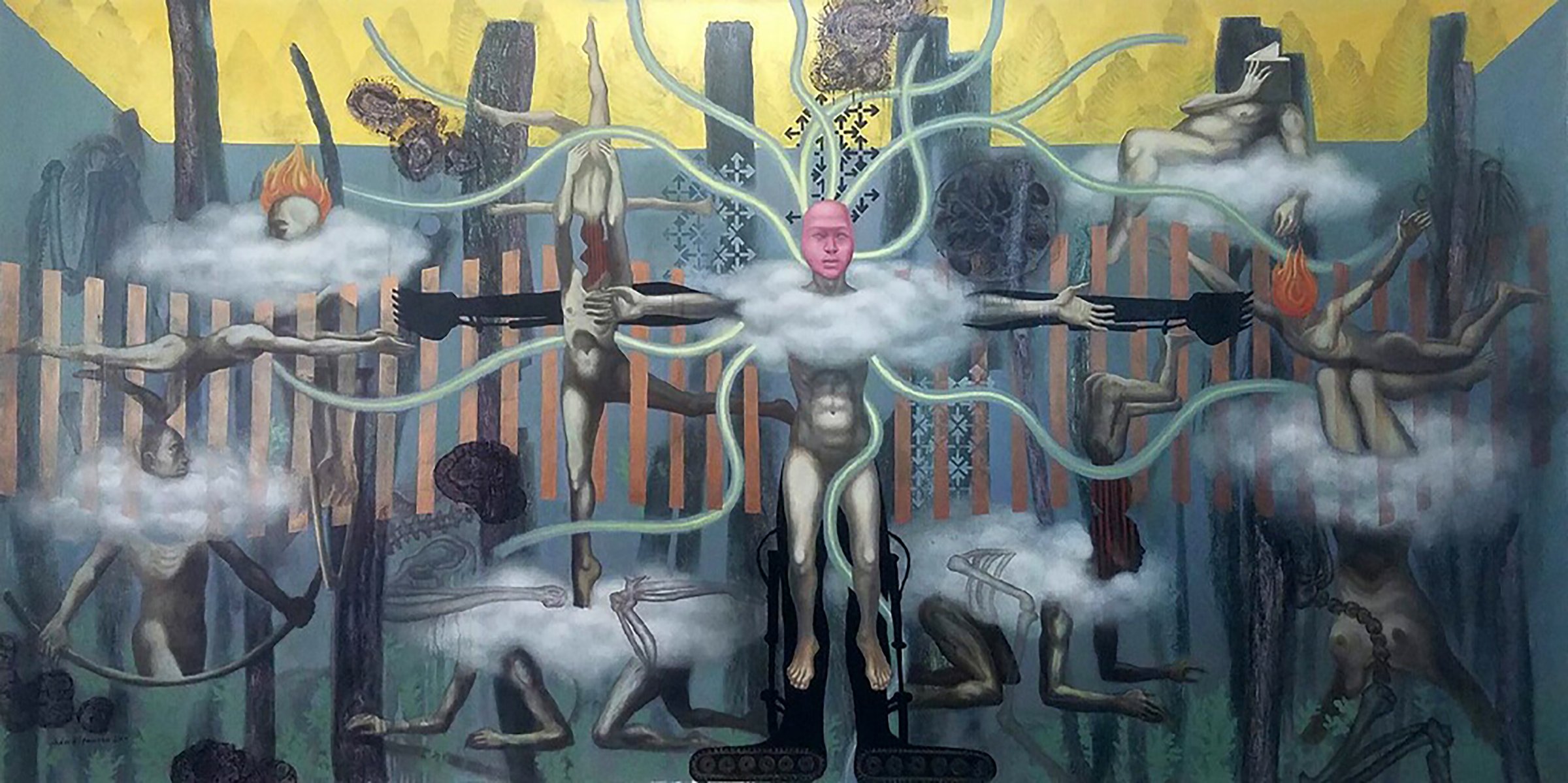
His most baroque meditation on the theme is Inhabiting False Heavens, a teeming mural-scaled allegory in which bodies sprout clouds where their heads should be — heads gone soft, gone vapor, gone into the comforting fog of belief — connected by a tangle of pale green tubes to a central pink-skulled figure mounted on tank treads. Picket fences, that most aspirational of suburban objects, recede into a forest. Flames bloom from skulls. It is a portrait of an entire society that has agreed to live in heavens it knows are false because the alternative is to look directly at the machinery underneath. The title does the whole job. The painting just makes it unforgettable.
The man on the stage, on fire
It would be a mistake to think of Bitancor only as a painter. For decades he has been one of the Philippines’ most committed performance artists — a body of work as urgent as the canvases and far harder to sell, which tells you something about why he did it. He performed at the Philippine International Performance Art Festival across the early 2000s, at the Tutok collective’s interventions, at Grace Exhibition Space in Brooklyn (Colonizador, 2009), at Bliss on Bliss Art Projects in New York, where he serves as art director. The titles are their own manifesto: Transcendence. Laissez-Faire. White Lies. Divine Providence. Katas ng Mansanas — Juice of the Apple — that troublesome fruit again. And, perhaps most tellingly, a 2004 filmed performance titled Burning Wings.
Hold that title. We’ll need it shortly.
The turn toward gold
Something happened in the last decade, and it is the most surprising chapter in the whole story. The painter of crawling bodies and skull-faced bureaucrats began to gild. He began to paint figures that levitate, balance, transcend — bodies caught in the act of defying the very gravity that had crushed his earlier subjects into the dirt.
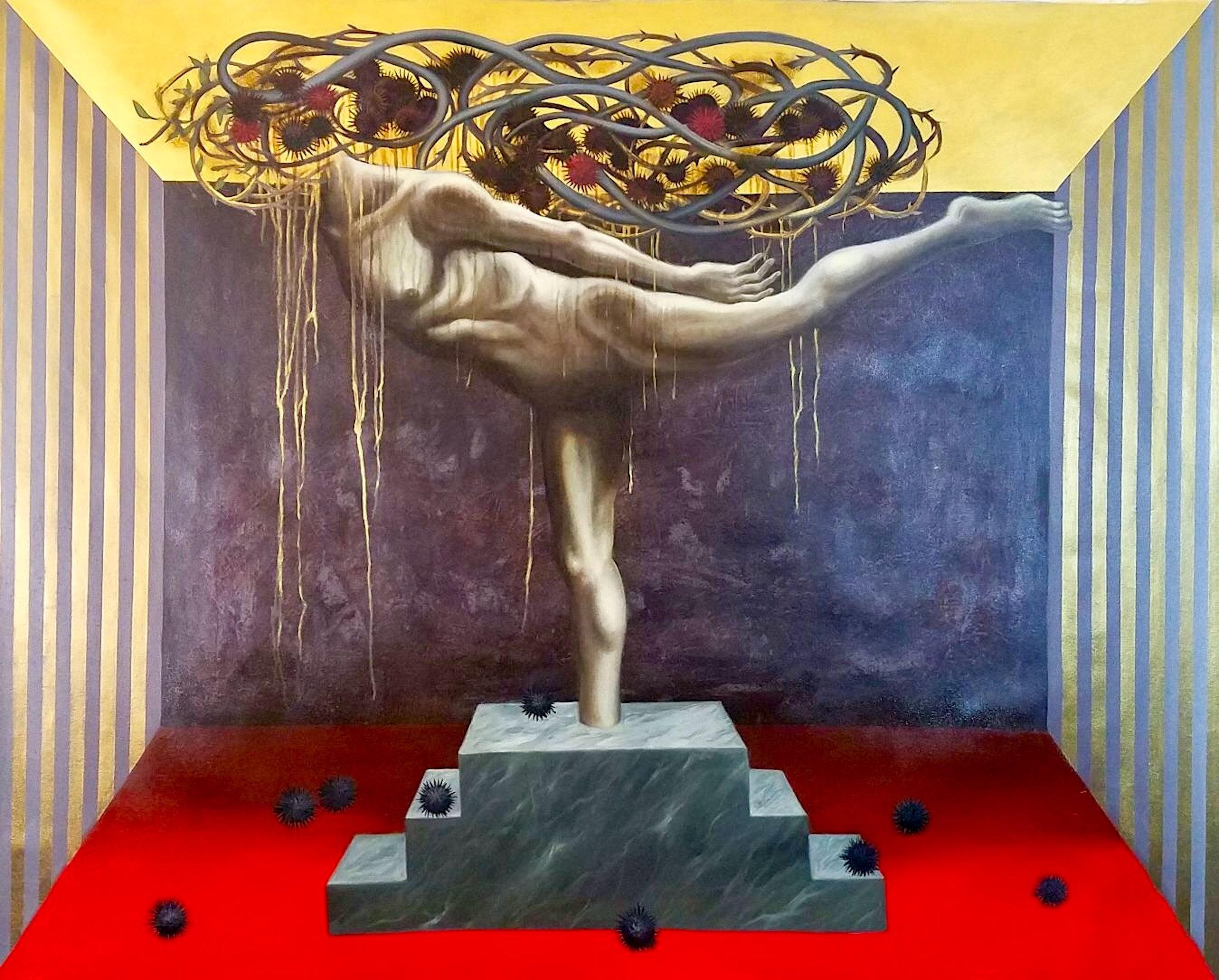
Plight is the hinge. A single golden figure balances horizontally on one impossible leg atop a stepped pedestal, body gleaming like a poured bronze, gold paint literally running and dripping off its limbs onto a blood-red floor, a thorny tangle of vine and burr crowning the gilded room above. Is it ascension or is it being bled dry? Is the gold a halo or is it a leak? Bitancor, true to form, refuses to say. The figure is at once a martyr, an Olympian, and a thing being slowly drained of its own luminosity. The irreconcilable contradiction, now performed in precious metal.
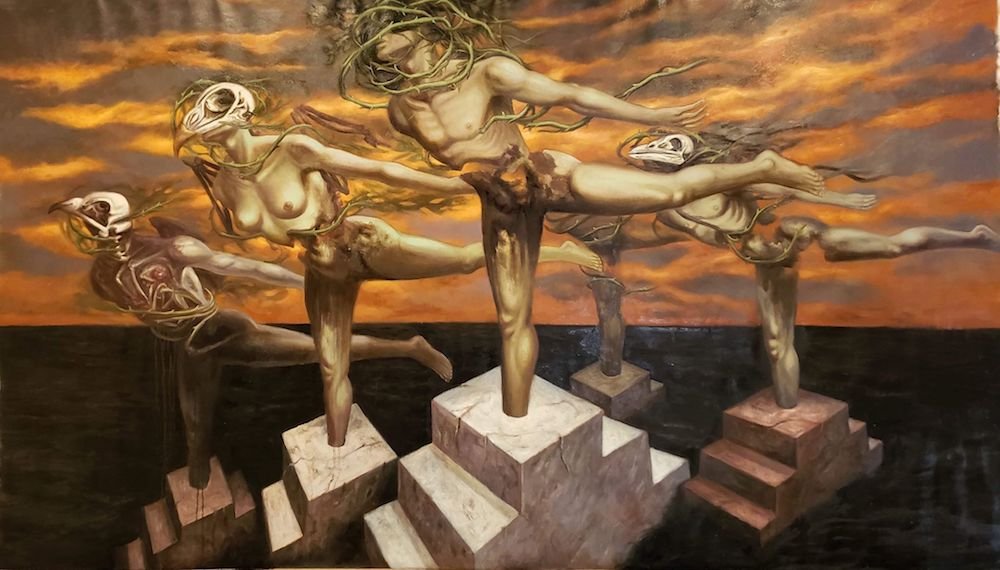
Plight No. 2 opens the scene out into landscape: a frieze of golden figures crowned with the skulls of birds, leaping and balancing across a staircase of marble pedestals that march out into a dark sea under a sky the orange of the end of the world. There is something of the classical relief here, something of Bacon, something entirely his own. The bodies are beautiful. The skulls are not negotiable.
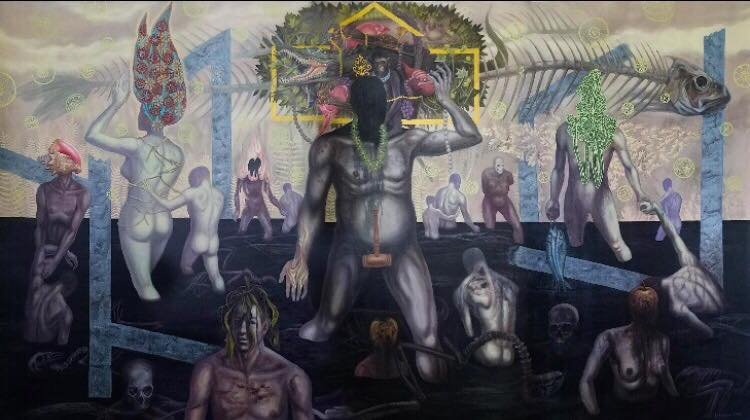
Polarity of Extremes is the monumental summation of this period — a vast horizontal cosmology in which a central grey figure raises a mallet over its head, surrounded by floating nudes, the fossilized skeletons of great fish, blue structural beams that frame the chaos like the bars of a cell or the lines of a ledger, and scattered skulls. It hangs between worlds: part Last Judgment, part autopsy, part dream. The “polarity” of the title is the whole career in a phrase — the permanent tension between the dot and Maria, Greenberg and Brecht, the beautiful surface and the unbearable subject, that Bitancor decided long ago to stop resolving and start inhabiting.
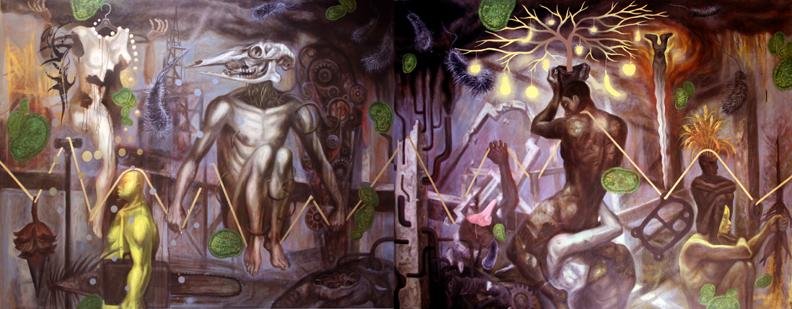
And then there is Lifeline, a diptych that may be the most generous thing he has made — two panels of decay and gear and bone on the left giving way, on the right, to a seated figure from whose head grows a bare tree hung with glowing lights, gold lightning-bolts of energy stitching the whole apocalypse together into something like a circulatory system. A lifeline. The hint, after all the diagnosis, of a current still running.
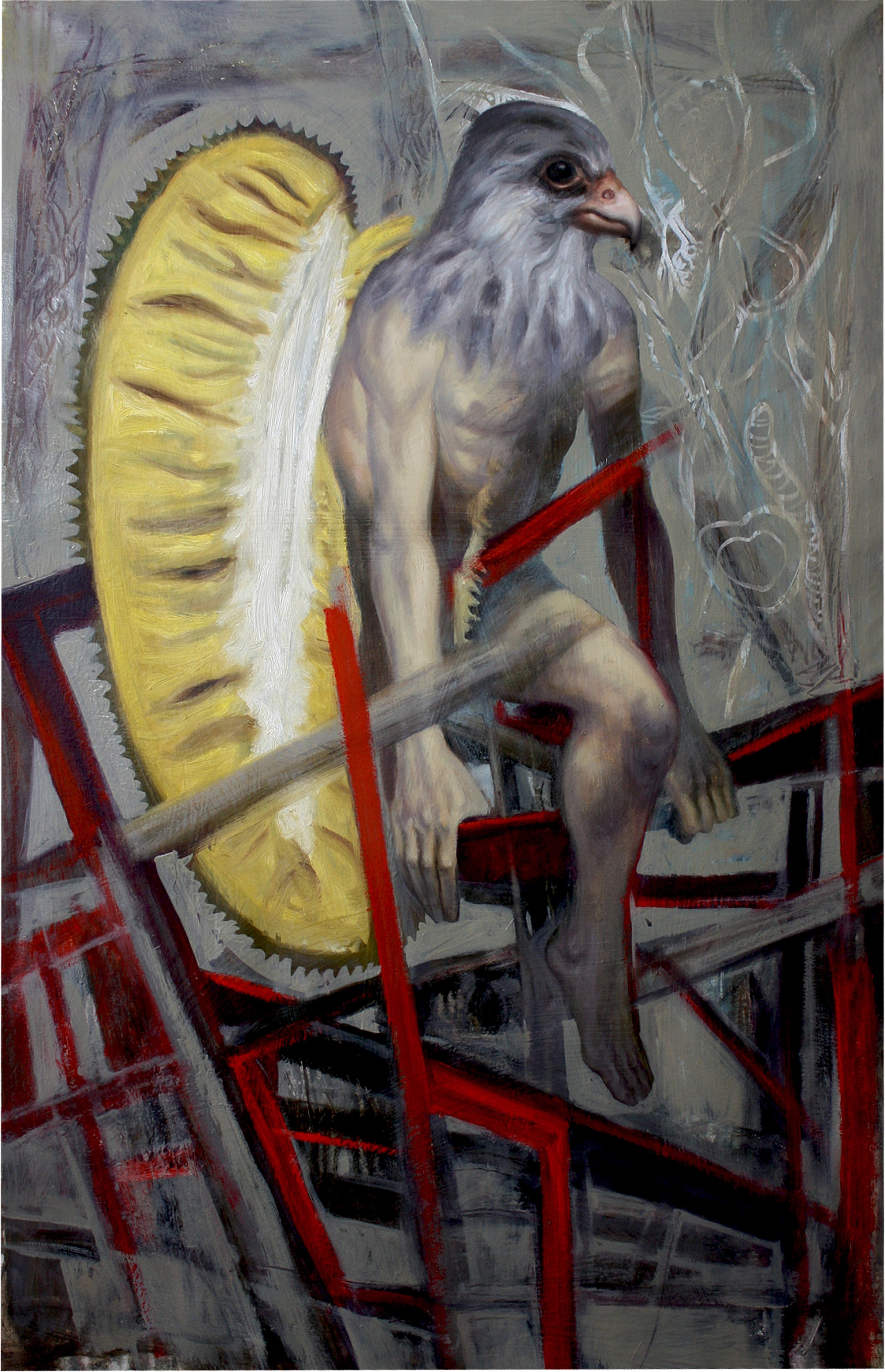
I would be remiss not to mention Igpaw — Leap, or To Vault Over — in which a kestrel-headed human figure perches on a cage of red scaffolding, a great toothed golden gear hovering behind it like a mechanical halo. The bird-man, caught between flight and machinery, between the wild and the engineered: it is the cleanest image he has ever made of his own situation, and the situation of any imaginative person trying to leap clear of the apparatus that wants to keep them perched.
The receipts
It is worth pausing, amid all this interpretation, to note that the art world has been paying attention for a very long time. He made his official entrance in 1995, with a debut solo exhibition under the Art Association of the Philippines — the opening of three decades of unbroken practice. In 1997 he won the Freeman Foundation Asian Artists Fellowship to the Vermont Studio Center, where he mounted his first one-man show in the United States, at the Red Mill Gallery — the same year he studied at the legendary Art Students League of New York. His painting Musmos took Best Entry in the nationwide Philippine Centennial competition. He has hung alongside the giants of Philippine art — among them BenCab, Ramon Orlina, Eduardo Castrillo, Pandy Aviado, and Tence Ruiz — at the 18th Asian International Art Exhibition at the Hong Kong Heritage Museum. And in 2006 the Cultural Center of the Philippines conferred on him the 13 Artists Award — the single most consequential honor a mid-career Filipino artist can receive, the imprimatur that says: this one will matter. Memento Mori, the twenty-foot leviathan this essay opened with, was his centerpiece for it.
He has had, by the latest count, twenty-seven solo exhibitions and well over a hundred group shows, across the Philippines, Singapore, Malaysia, Vietnam, Hong Kong, Taiwan, Japan, Thailand, and the United States. In 2018 the Iloilo Museum of Contemporary Art mounted a full museum survey, sponsored by Megaworld, under a title that has since become the standard description of the man: Poetic Dissent: The Art of Jeho Bitancor. His work lives in the permanent collections of the Singapore Art Museum, the Ateneo Art Gallery, the National Commission for Culture and the Arts, the University of the Philippines Heritage Museum, the De La Salle University Museum, the Cojuangco Museum, the Iloilo Museum of Contemporary Art, the Soka Gakkai Cultural Center in Malaysia, the Social Security System collection, and — in the detail that always moves me most — the Tahanang Walang Hagdan, the “House With No Stairs,” the Philippines’ great institution for persons with disabilities. The painter so obsessed with ladders and stairs and the agony of ascent hangs, permanently, in a house built to need neither.
He is in the Encyclopedia of Philippine Art. He is the subject of essays by the scholar Reuben Cañete. And through all of it he has kept writing the poems and the reviews, and kept making the performances that no museum can put in a vault.
What the paintings demand of us
Read his 2026 statement and you will find a man who has not mellowed so much as deepened. “I have always treated art,” he writes, “as a way to concretize thoughts that manifest my stance regarding its very nature, what it serves and what it is capable of.” He still wants art to do something. But listen to the verbs he chooses for himself now: “I exist to experience, emphatise, advocate, discover, appreciate, contradict and be exalted with life.” Contradict sits right there in the middle of the sentence, unrepentant, between appreciate and exalted. The man who couldn’t choose between Greenberg and Brecht built a whole ethics out of the refusal. And the sentence ends not with a doctrine but with a confession — that all of it is done “with the aid of a human activity that demands mostly honesty.”
Mostly honesty. Even here, the wink. He is too honest to claim total honesty.
“I exist to experience, empathise, advocate, discover, appreciate, contradict and be exalted with life — with the aid of a human activity that demands mostly honesty.”Jeho Bitancor, Art Statement, 2026
Back in the earlier statement, he gave the credo plainly: “an artist’s contribution is his unique visual language as envisioned through his own mind, perceived through his own eyes and felt through his own heart.” It sounds like a platitude until you have spent an afternoon with the actual eyes and the actual heart in question — until you have walked the twenty feet of Memento Mori, stood inside the skull-grin of I See No One But Me, watched Darna iron her own cape — and realized that this man has, in fact, invented a visual language that belongs to no one else. Pig-suited ministers and broccoli altars. Bodies that sprout clouds and trees and gun-barrels. Gold that might be glory and might be hemorrhage. A whole grammar of “alienation, conspiracy, displacement, resistance and assertion,” built figure by figure over thirty years.
A fang in the wing
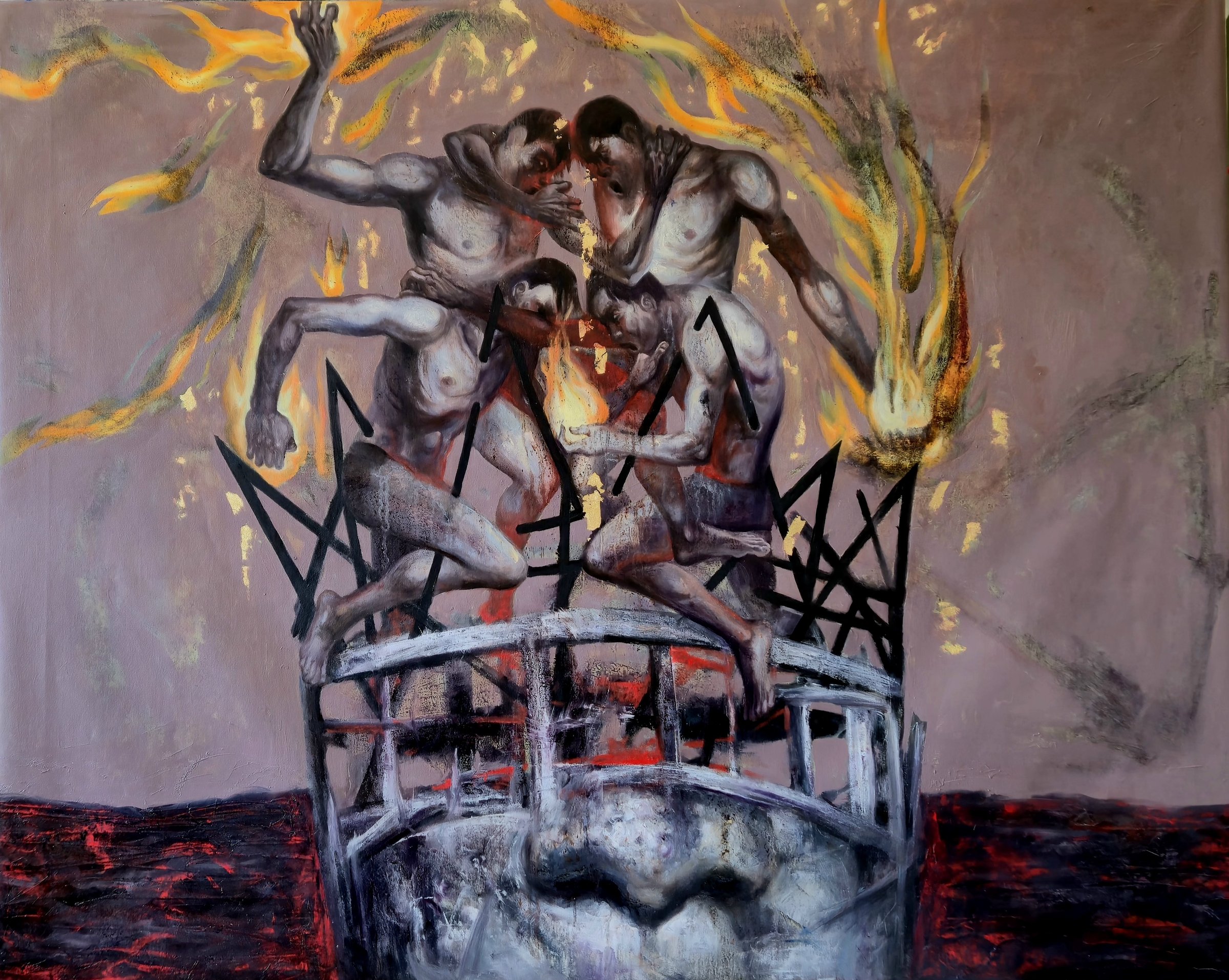
In Nagtutunggaling Magkauri — those of the same class locked in conflict — there is no comfortable place to put your eyes. Bodies grapple, wound, and contort against one another, skewered by black iron bars reconfigured as a crown. They are not natural enemies. They have been made into enemies by the fallacy and deception that divide a nation, driven to battle over loyalty and ego even as their shared future is what hangs in the balance. Faith has curdled into false veneration; allegiance has made truth and lies indistinguishable. While people inflict pain and suffering upon their own, the real authors of that suffering remain beyond reach, enjoying impunity and luxury.
The crown tells you who benefits. It rises from the crumbling head-monument of the late Ilocano dictator, yet bears the iconic punctured nose of the past president — two authoritarian inheritances fused into a single ruinous idol. Populism does not merely enthrone a leader here; it rearranges the people beneath him into instruments of one another’s destruction. The monument crumbles, but its logic survives. Bitancor’s 2025 solo exhibition at Altro Mondo carried a title that answered that inheritance with something sharper: Pangil sa Pakpak — a fang in the wing. The thing that flies now has teeth.
This, I think, is the surprise that thirty years have been building toward, and it is not the one you would expect from a Social Realist. It is not despair. Bitancor began as the painter who showed us the cage — the org-chart crucifixions, the crawling migrants, the bureaucrats who see no one but themselves. He has arrived, without abandoning a single one of his quarrels, at the painter who shows us how the cage recruits its own prisoners: how domination survives by teaching people to mistake one another for the enemy. Yet Pangil sa Pakpak, from last year, refuses helplessness. The wing has grown a fang; vulnerability has discovered a means of defense. The chair, it turns out, is still meant to be sat upon. He simply set it on fire first, to see who would have the nerve to sit.
So what comes next?
Sa Pagitan ng Bangungot at Bahaghari
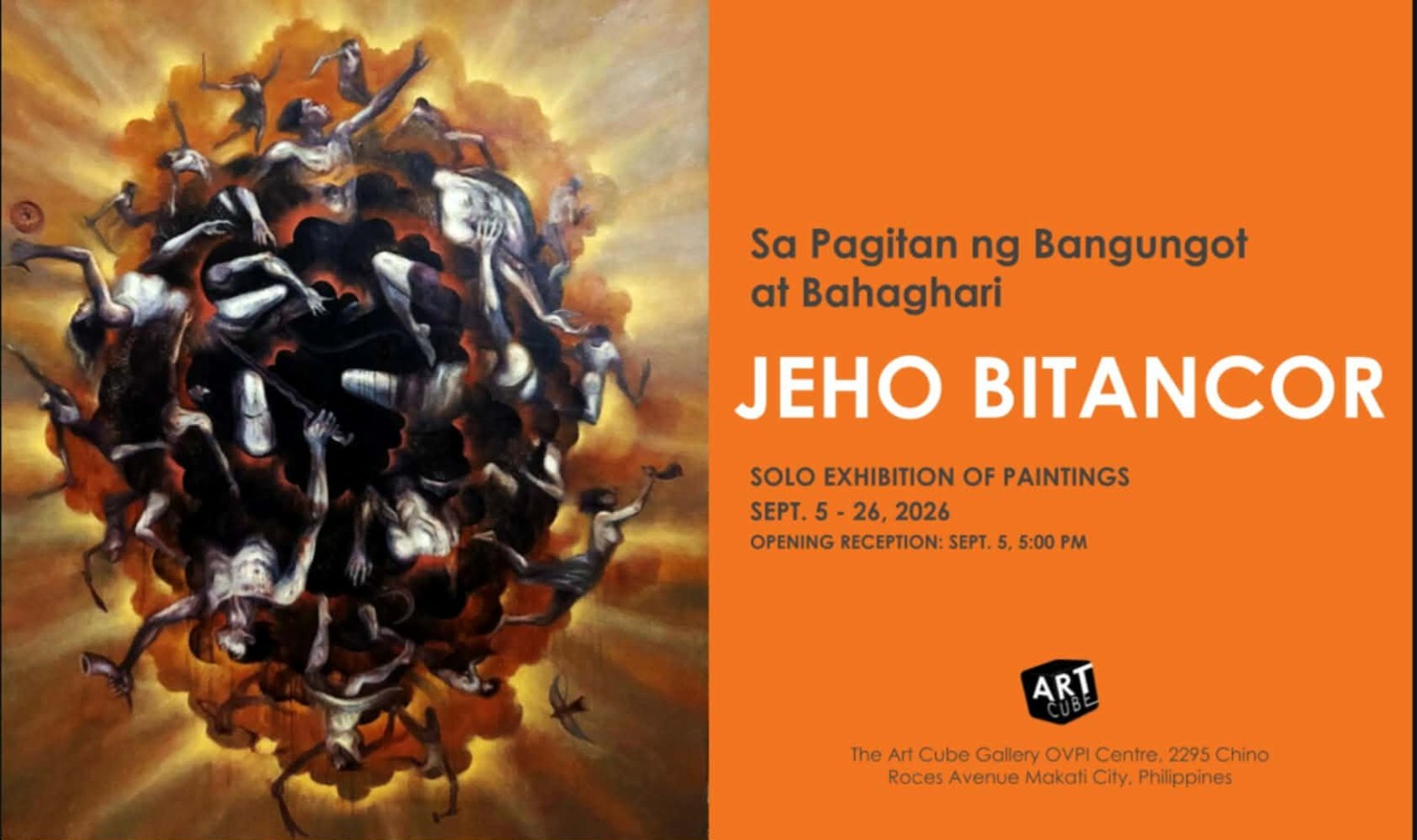
And now the door is opening. Bitancor unveils his twenty-eighth solo exhibition, Sa Pagitan ng Bangungot at Bahaghari — the show this whole restless year has been building toward. I have seen enough of what is coming to tell you that the contradictions in these 2025 canvases have not been resolved but sharpened, that the chair is being set for something, and that the man who has spent thirty years refusing to choose is about to make the rest of us sit down and look. Mark the date. Consider this both the warning and the invitation.
Watch this space. The extraordinary alien is not finished with us, and his best argument — the one he has been having with himself since a studio in Diliman in the 1980s — has not yet reached its last word. Knowing him, it never will. That is the point.